Friday, March 4, 2011


Thursday, March 3, 2011
Mareb Press had DOS attach from Saleh Foundation

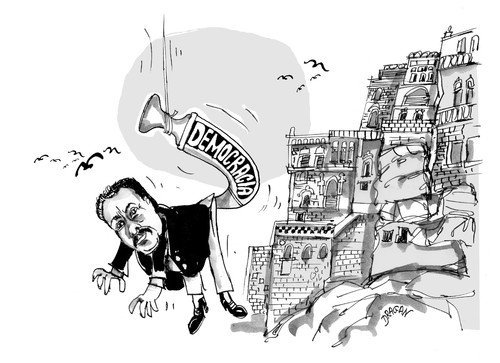
The Last Days of Yemen’s Despot
Posted by Frank Crimi on Mar 3rd, 2011 and filed under Afternoon Edition, Daily Mailer, FrontPage. You can follow any responses to this entry through the RSS 2.0. You can skip to the end and leave a response. Pinging is currently not allowed.
As Yemen’s embattled President Ali Abdullah Saleh struggles to maintain power, he is lashing out and accusing both Israel and the United States of orchestrating the ongoing unrest in his country and throughout the entire Middle East. While Saleh’s conspiratorial outburst may find some appeal with the Yemini populace, it will do little to staunch what increasingly looks to be the inevitable end to his rule.
Speaking to a group of students and academics in the capital city of Sanaa, Saleh darkly intoned, “I am going to reveal a secret. There is an operations room in Tel Aviv with the aim of destabilizing the Arab world. The operations room is in Tel Aviv and run by the White House.”
Not content to leave it at that, Saleh said that those operations had extended to Yemen: “Regrettably those [opposition figures] are sitting day and night with the American ambassador where they hand him reports and he gives theminstructions. We say that this is a Zionist agenda.”
Saleh’s conspiratorial remarks came as Yemen saw the largest anti-governmentdemonstrations to date. Tens of thousands of Yemini citizens took to the streets of the capital city of Sanaa chanting, “The people want the downfall of the regime.” The large size of the protest was credited to the participation of opposition political parties, including the Socialist Party, which ruled south Yemen before merging with the north in 1990.
Saleh’s statements drew a quick and direct response from US State Departmentspokesman PJ Crowley: “The protests in Yemen are not the product of external conspiracies. President Saleh knows better. His people deserve a better response.”
Unfortunately, playing the anti-Semitic card as a ploy to divert attention to his increasing troubles may be Saleh’s only answer. His problems, and by extension those of Yemen, mirror the template seen in the uprisings in Tunisia, Egypt and Libya. In those cases, the script for unrest was pretty much the same: public outrage at official corruption, high unemployment, overwhelming poverty and overbearing authoritarian rule.
Saleh’s response to those conditions has also been consistent with those used by Tunisian President Zine El-Abidine Ben Ali and Egyptian President Hosni Mubarak. While acknowledging the need for political and economic reforms, Saleh’s answer was to present them in a way that would not upset the ruling order of the country. He said his package of reforms was designed to “calm the situation and heal the rift between all political forces and maintain the security, stability and unity of the country.”
In a case of too little, too late, his proposed reforms, as well as a promise to step down as president in 2013, did little to mollify his opponents who saw Saleh’s ouster as the nonnegotiable starting point.
So, ratcheting up the rhetoric, Saleh has refused to step down, rejected calls to set up a national unity government, and declared: “The opposition is bankruptand possesses no programs.”
Finally, as the pressure for his removal has mounted, such as losing the supportof his own tribe, Saleh, took a page from Qaddafi and said he would defend his regime “with every drop of blood.” Saleh seemed bent on fulfilling that pledge as demonstrations over the past several weeks have seen government securityforces wound hundreds of people and kill 27.
So, while the script playing out in Yemen has a familiar look, it still does not ensure that it will end in Saleh’s ouster. However, the presence of two additional elements may prove to be the decisive determining factors.
Faced with open rebellions in its northern areas and a separatist movement in the south, the Republic of Yemen’s Government’s control (ROYG) of the country is limited to a tiny pocket outside the capital city of Sanaa.
Second, and perhaps more importantly, Yemen is also home to al Qaeda in the Arabian Peninsula (AQAP), declared in December 2010 by the US government to be America’s greatest terrorist threat. AQAP’s rise in power is such that Yemen is viewed by intelligence analysts as the logistical and training hub for global jihadists.
Yemen is also the home to notorious cleric and top leader, American –Yemini, Anwar Al Awlaki, who has been linked to, among others, Umar Farouk Abdulmutallab, the accused Christmas Day bomber, as well as to Major Nidal Hasan, the Fort Hood shooter who killed 13 people in 2009.
As such, the danger posed by AQAP gives the US a vested interest in keeping Yemen from delving into a morass of civil anarchy. While the American relationship with Saleh and his government has been rocky over the years, it still hasn’t prevented the ROYG from being the recipient of over $500 million in American military and economic aid. So, it was somewhat surprising that Saleh would now accuse the US of being behind his current troubles.
In the end, however, the danger for the United States and the Mideast is not in the ouster of Saleh or the collapse of the ROYG but which political forces eventually assume control of the country. With AQAP having established a strong and growing foothold in Yemen, it makes that country — more than any Arab country — ripe to emerge as an Islamist state.
For its part, AQAP is further laying the groundwork for such an eventuality by voicing a public appeal to the Yemini people. In an audio tape released by Ibrahim al-Rubeish, a former AQAP detainee at Guantanamo Bay detention facility, al-Rubeish said the goal of the rebellion was not to just overthrow one long-term ruler but to replace him with a government based on Sharia Law. As he said, “One tyrant goes, only to be replaced another who may fix for the people some of their worldly issues by offering job opportunities and increasing their income, but the greater problem remains.”
Hopefully, the ominous appearance of Sheik Abdul Majid al-Zindani at the latest anti-government protest doesn’t portend the direction Yemen will one day take. Al-Zindani, a founder of the Islamic opposition Islah Party, has been on the US Treasury Department’s list of “specially designated terrorists” for fundraising for al Qaeda and other terrorist groups. Speaking to the crowd, al-Zindani warned the government not to use force against demonstrators: “We hail the peaceful revolution of the youths and their legitimate demands and rights. Go on until you achieve your demands.”
It became disturbingly clear what Zindani’s demands were when he then declared, “An Islamic state is coming!” If that does happen, it won’t be because of some fantasized Israeli and American conspiracy, but by Saleh’s own failures spread out over thirty years of corrupt rule.
Frank Crimi is a writer living in San Diego, California. You can read more of Frank’s work at his blog, www.politicallyunbalanced.com.
source:http://bit.ly/fGpwha
South Yemen separatists find hope in spreading unrest

ADEN, Yemen |
(Reuters) - Revolts in southern Yemen, inspired by popular uprisings that toppled leaders in Tunisia andEgypt, are taking on a different tone, raising hopes in the south that an independence lost two decades ago can be regained.
In qat saloons, where people gather daily to chew the stimulant qat leaf, the talk is of southern Yemen's decline and the prospects for a separation from the more tribal north.
"(President Ali Abdullah) Saleh, like the rest of the Arab tyrants, will go down. It will be a crucial step toward regaining the south's independence," said financial adviser Yassin Makkawi, as he chewed qat and sipped on a sweet drink.
Nationwide protests against Saleh's 32-year rule have intensified over the past two weeks, and most of the 24 reported deaths have been in the south. Although separatist sentiment is running high, protestors in the former capital Aden have mostly stuck to slogans used by northerners for Saleh to leave power.
Southerners say they have seen their incomes decline, society become more religiously conservative, corruption become more widespread and their home city of Aden lose the leftist spark that gained it the nickname "Cuba of the Middle East."
After striking a shaky unity deal with the north in 1990, a civil war erupted four years later, which the south lost.
"Even the water used to taste better before. Unity has been a disastrous experience in every way. We never imagined that a united Yemen would mean discrimination and domination of our land and resources," Makkawi added.
The bloody uprising in Libya, and January's independence referendum in southern Sudan, just across the Red Sea, has also bolstered hopes of independence.
The mostly northern security forces have pulled back from Aden in the last several days. Police units, known as central security, man road blocks but are mostly letting people through. Traffic, however, remains thin. Popular fish eateries, known as mikhbazas, are doing less business.
SOUTHERN IDENTITY
In Aden, a cosmopolitan port that had declined in importance by the time the south gained independence from British colonial rule in 1967, residents say the north-dominated government has been eroding their way of life.
They point to a civic tradition and a spirit of tolerance that survived the Soviet-style political system of the People's Democratic Republic of Yemen, as the south was formally known.
"I remember playing soccer with Christian and Jewish children in the streets. The full face veil women wear now in Aden was not known to us," said engineer Mohammad Aman.
"Saleh and his bunch are not satisfied with taking our land and depriving us of a voice in government. They have been trying to smash our identity, the songs we used to sing, even the architecture. Aden used to have beige buildings in harmony with nature, not the technicolor mess they brought," he added.
Asked whether unity was possible without international support -- Saudi Arabia finances Saleh and the United States considers him an ally in its war against al Qaeda -- Tamam Bashraheel said the president was losing his usefulness.
"The West has started to understand the game. They are getting to know that Saleh's argument as the bulwark against al Qaeda and instability is false," said Bashraheel, the publisher of the al-Ayyam newspaper, which was banned two years ago.
"Southern society is religious but moderate. Al Qaeda will lose any foothold in a democratic south," he added.
Most of the violence in Aden took place in the commercial Mouala district, which has relatively prosperous businesses compared with Yemen's yearly per capita national income of a little over $1,000. A large British cemetery sits along the main street and a derelict Jewish one is hidden behind a wall.
One of Aden's main sites, a picturesque fort on top of giant volcanic rocks overlooking the deep blue Arabian Sea, has attracted zero visitors since the demonstrations intensified two weeks ago.
"The fort was renovated last year and we got up to 15 Western tourists a week. Now there is no one. It has not been easy even for me to get here," gatekeeper Ahmad Abdulwahed said.
But not all southerners are in favor of the protests, or nostalgic about the time the south was independent, remembering instead the autocratic socialist party and its heavy-handed nationalization of the economy.
"I used to stand in line for hours with my mother to buy bread. Saleh has overstayed his welcome and he might as well declare Yemen a hereditary republic. But the alternative is not sabotage," said Mustafa Khader, who makes a modest living selling used cars.
"Aden always took the brunt of political crisis," he said, referring to the 1994 conflict and a southern civil war in the 1980s that killed thousands. "We want to be spared this time."
Source: http://reut.rs/i3OVlg